
Every parent who has sat with their child after a long day, gently nudging them to open the Quran, knows how delicate that moment really is. It is not just about recitation. It is about the relationship being built — word by word, surah by surah, heart by heart.
The question of how to make Quran interesting for children at home is one of the most searched concerns among Muslim parents today, and for good reason. Children absorb the world through emotion, curiosity, and play. When the Quran enters their world through warmth and wonder, it stays. When it enters through pressure and obligation alone, it is often resisted.
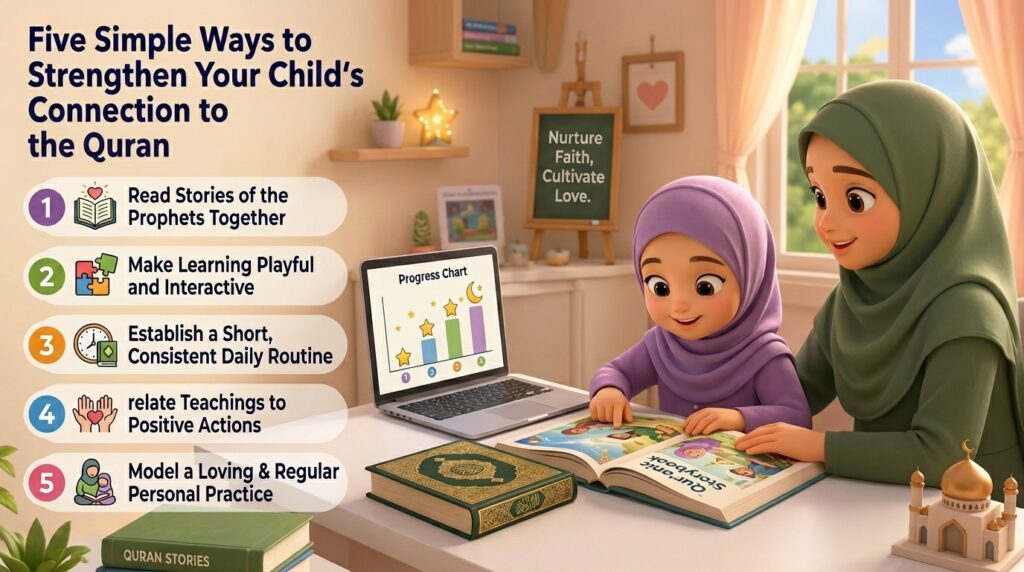
This article outlines five simple, spiritually rooted ways to nurture a child’s deep and lasting bond with the Quran — through listening, storytelling, incremental learning, family engagement, and heartfelt du’ā, grounded in Prophetic teachings and noble character.
Why the Early Years Matter Most
Before diving into the five ways, it helps to understand why early exposure carries such weight.
Children between the ages of three and seven are in a critical window of neurological development. Their brains are particularly receptive to new sounds, rhythms, and patterns. Quran learning for kids during this phase does not just build a spiritual foundation — it sharpens memory, enhances focus, and builds the emotional regulation skills that will serve them throughout their lives.
The Prophet Muhammad (peace be upon him and his progeny) is reported to have said: “The best among you is the one who learns the Quran and teaches it.” (Sahih al-Bukhari). This hadith is not addressed only to scholars. It is a call to every household — to make the Quran a living presence, not a shelf decoration.
Way 1: Create a Listening Environment Before Formal Learning Begins
One of the most underestimated strategies to teach Quran to children at home is simply letting them hear it — repeatedly, gently, and without pressure.
Parents can play Quranic recitations softly in the background during breakfast, in the car, or before bedtime. The child’s mind begins to absorb the melody, the rhythm, and the emotional texture of the words long before any formal lesson begins. This is not passive exposure. It is foundational.
Quranic recitation for children in this informal, ambient way creates familiarity. And familiarity creates comfort. When a child later sits to learn the same verses in a structured setting, they are not meeting strangers — they are meeting old friends.
Practical Habit to Apply
Select one or two trusted reciters whose style is clear and calm.
Play a short surah — such as Surah Al-Fatiha or Surah Al-Ikhlas — on repeat during a single daily activity.
Within two weeks, observe the child naturally attempting to repeat sounds. Encourage this without correcting immediately.
Way 2: Use Quranic Storytelling as the Gateway to the Heart
Children have always learned through stories. The Quran itself acknowledges this beautifully: “We narrate to you the best of stories.” (Surah Yusuf, 12:3). This is not a coincidence — it is a methodology.
Quran stories for kids are among the most powerful tools available to parents. The stories of Prophet Ibrahim (a.s), the patience of Prophet Ayyub (a.s), the courage of Lady Fatimah (a.s), and the wisdom woven into the life of Imam Ali (a.s) are not just historical accounts. They are living lessons in character, resilience, and love for Allah.
Parents who invest even ten minutes per day in narrating these stories — with expression, imagination, and occasional questions — are building a child’s emotional and spiritual vocabulary simultaneously.
How to Make Storytelling Stick
Choose one Quranic story per week. Keep it age-appropriate and emotionally engaging.
After narrating, ask one open-ended question: “What do you think the Prophet felt when that happened?”
Connect the lesson to the child’s own daily life — a moment of forgiveness at school, a test of patience at home.
This approach directly helps parents wondering how to make Quran interesting for children at home without turning sessions into lectures.
Way 3: Build Incremental, Joyful Daily Habits — Not Lengthy Sessions
A common mistake many parents make is equating commitment with duration. Long, forced sessions rarely build love. Short, joyful daily Quran habits for children do.
The goal is not to complete a page. The goal is to end every session with the child wanting more.
For younger children (ages 3–7), five to ten minutes of engaged recitation is far more valuable than forty minutes of reluctant repetition. For older children (ages 8–12), fifteen to twenty minutes of meaningful, explained recitation builds both Tajweed for kids and genuine understanding.
Quran memorization for kids works best when it is tied to a positive emotional anchor. A small celebration when a new ayah is memorized, a sticker chart on the wall, or simply a warm hug from a parent — these signals tell the child’s brain: this matters, and it feels good.
A Simple Daily Habit Framework
TimeActivityDurationMorningListen to a short surah while getting ready5 minutesAfter AsrRecite one new ayah with parent10 minutesBedtimeStory from Quran / reflection10 minutes
This framework is light, consistent, and spiritually alive. It builds daily Quran habits for children without overwhelming the family’s schedule.
Way 4: Involve the Whole Family — Make It a Shared Experience
The Quran was not revealed into isolation. It came into a community, a family, a shared life. When Quran recitation for children becomes a family ritual rather than a child’s solo obligation, everything changes.
Children mirror their parents. If a parent opens the Quran daily — even for five minutes — the child sees that this is simply what people in this household do. It is not punishment. It is not a chore. It is identity.
Fun Quran activities for children can extend beyond recitation too. Families can hold weekly “Quran reflection circles” — where each member shares one verse that meant something to them that week. Older siblings can play the role of a junior Quran teacher for kids, reviewing a sibling’s recitation. This creates ownership, pride, and joy.
Family Engagement Ideas
Surah Challenge: Memorize a short surah together as a family over two weeks. Celebrate completion.
Meaning Discovery: After recitation, ask: “Does anyone know what this word means?” Introduce one Arabic word per session.
Quranic Journal: Encourage children above age eight to maintain a small notebook where they write their favourite verse of the week and what it means to them.
This communal approach makes the Quran feel like a warm, shared inheritance — not a solitary duty.
Way 5: Pair Home Learning with a Qualified, Child-Centred Quran Teacher
Even the most dedicated parents reach the limits of what they can teach alone. At some point, every child benefits from a qualified Quran teacher for kids — someone who understands child psychology, knows the rules of Tajweed for kids, and can provide the structured progression that home sessions alone cannot always offer.
This is where online Quran classes for kids have transformed access for Muslim families worldwide. A child in Lahore, London, or Los Angeles can now learn from a skilled teacher without the logistical challenges of travel or rigid timetables. The best platforms pair certified teachers with personalised lesson plans, ensuring every child progresses at their own pace — without pressure or comparison.
When choosing a platform or academy for Islamic studies for kids, parents should look for:
Qualified and patient teachers — those trained in child-centred pedagogy, not just classical Tajweed
Structured yet flexible curriculum — one that progresses from Noorani Qaida to recitation to understanding
Real-time feedback and parental updates — so home learning and classroom learning reinforce each other
Small class sizes or one-to-one options — to ensure no child is left behind
Online Quran classes for kids work best when they complement, not replace, what is already happening at home. A session with a teacher reinforces the emotional investment parents build daily.
What to Ask Before Enrolling
Before choosing the best online Quran academy for kids, parents can ask the following:
Does the teacher explain meaning, or only pronunciation?
How is a child’s progress tracked and shared with parents?
What happens if a child falls behind or loses motivation?
Are there trial classes available before full enrolment?
The right answer to the last question should always be yes. Any serious academy is confident in the experience it delivers.
The Heart of It All: Connecting Children with Quran Meaning
Recitation without understanding is a starting point, not a destination. The true goal of every parent, teacher, and academy should be to genuinely connect child with Quran meaning — to make the words live in the child’s conscience, not merely on their tongue.
This is what separates a child who recites the Quran from a child who loves it. The former may drift away when pressure eases. The latter carries it into every room they enter.
Quran learning for kids built on meaning — where a child understands that “ar-Rahman ar-Raheem” describes a God who is endlessly compassionate — creates a spiritual relationship that lasts beyond childhood. It becomes the lens through which they see justice, patience, gratitude, and service.
Parents who combine all five ways outlined above — listening, storytelling, consistent habits, family participation, and qualified guidance — are not simply raising children who memorise verses. They are raising children who understand why those verses matter.
Closing Reflection: A Child’s Love for the Quran Begins at Home
No academy, however skilled, can replace what a parent does in the quiet moments of daily life. The soft recitation played in the morning. The story told before sleep. The shared du’ā at the dinner table. These are the seeds of a child’s love for the Quran — and they are planted at home.
Online Quran classes for kids extend and deepen what parents begin. A qualified teacher refines pronunciation and structure. But it is the parent who teaches the child to love. And that love, once rooted, becomes a tree whose shade never leaves.
May every child be raised under that shade.
At Quranic Rise Academy, the belief is simple: the Quran meets the heart — not just the memory. Every session is designed to build understanding, character, and genuine connection. Explore our programmes for children of all ages and let the journey begin.